Tuesday, 8 March 2016

Jesus as Chasidim - Mark 1:29-34

29 As soon as they left the synagogue, they went with James and John to the home of Simon and Andrew. 30 Simon’s mother-in-law was in bed with a fever, and they immediately told Jesus about her.31 So he went to her, took her hand and helped her up. The fever left her and she began to wait on them.32 That evening after sunset the people brought to Jesus all the sick and demon-possessed. 33 The whole town gathered at the door, 34 and Jesus healed many who had various diseases. He also drove out many demons, but he would not let the demons speak because they knew who he was.

Jesus heals a number of people of various ailments throughout the book of Mark. This is not uncommon in writings of the time about other great Rabbis and the assumption is not that the individual themselves performed the healing, but their favor with God meant that God did the healing at their behest.


In fact, the literature of the time, both Jewish and non-Jewish, is filled with healings and other miracles being attributed to important figures. This seems to be a common literary device to affirm the importance and validity of the figure being discussed. For example, Pythagoras, the Greek mathematician and philosopher, was "documented" as having performed a series of miracles that rivals anything found in the Gospels.

Jesus has no recognized right by mainstream Jewish tradition to offer his own teaching, his own Mishnah, or interpretation of Scripture.  Not having been certified by semicha, rabbinic ordination, Jesus did not have, s'mikhahto, "authority".  His claim to legitimacy and the right to speak rests on being a Chasidium, a Rabbi who can dispense the mercy of God.  The examples the writer of Mark gives of God dispensing his mercy through Jesus in the form of healing and exorcism are an effort to validate Jesus and his teaching by demonstrating God's willingness to work through him.  
Hasidim/Chasidim (Hebrew: חסידים‎) is the plural of Hasid (חסיד), meaning "pious". The honorific "Hasid" was frequently used as a term of exceptional respect in the Talmudic and early medieval periods.... The literal meaning of "Hasid" derives from Chesed-"kindness", the outward expression of love for God and other people. https://en.m.wikipedia.org/wiki/Hasidim
Bruce Chilton, in his book, "Rabbi Jesus: An Intimate Biography", describes a Chasidium as a Rabbi who was able to dispense the mercy of God by curing sickness or relieving drought through prayer. They were ancient Judaism's shawmans, faith healers, witch doctors and sorcerers. The term was first applied to Jews during the Maccabean revolt following the desecration of the Temple by the Seleucids in 167 B.C.E. who preferred to die rather than do violence on the Shabbath (1 Maccabees 2:29-48). Having known the "chesed", the compassion of God, they refuse to betray him. That Jesus followed in this tradition might also be surmised by his refusal to allow his disciples to defend him using violence when he is arrested in the Garden of Gethsemane when his execution was a foregone conclusion.

A famous Chasidium who was a contemporary of Jesus was Chanina ben Dosa. He lived near Nazareth and said healing stemmed from the fluency of his prayer. He was famous for healing the son of Gamaliel, a leader of the Pharisees in Jerusalem.


The stories of Jesus' miracles, healings, and mighty deeds in the Gospel are used to establish his right to offer a Mishnah under an alternate Jewish tradition as well as using the established literary device common to the Mediterranean region of the time to affirm Jesus' importance and validity. 

Sunday, 6 March 2016

Impure Spirits? - Mark 1:21-28

21 They went to Capernaum, and when the Sabbath came, Jesus went into the synagogue and began to teach. 22 The people were amazed at his teaching, because he taught them as one who had authority, not as the teachers of the law.23 Just then a man in their synagogue who was possessed by an impure spirit cried out, 24 “What do you want with us, Jesus of Nazareth? Have you come to destroy us? I know who you are—the Holy One of God!”
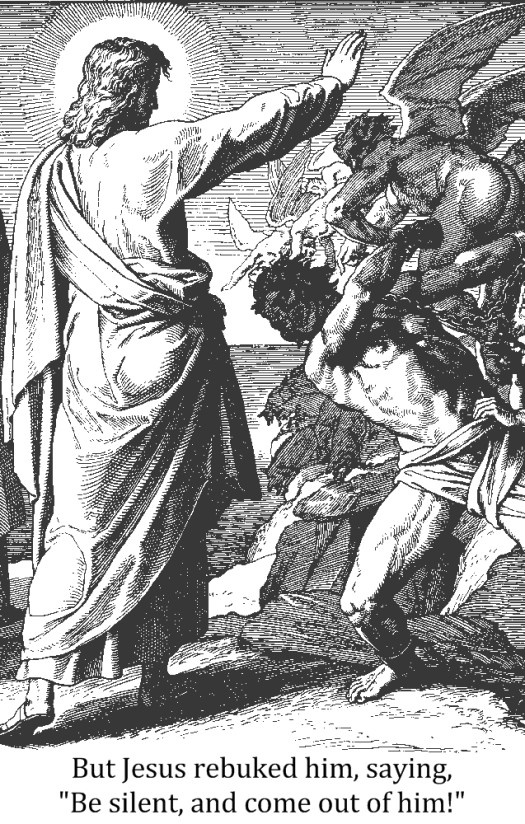
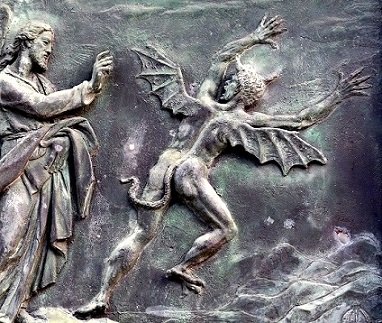
25 “Be quiet!” said Jesus sternly. “Come out of him!” 26 The impure spirit shook the man violently and came out of him with a shriek. 27 The people were all so amazed that they asked each other, “What is this? A new teaching—and with authority! He even gives orders to impure spirits and they obey him.” 28 News about him spread quickly over the whole region of Galilee.


So far in Mark's story, Jesus' right and authority to give his own teaching is based solely on the testimony of supernatural beings and supernatural events.  Occurrences such as the voice from Heaven when he is baptized, and the healings and exorcisms he has performed which demonstrated God's favor are the proof of his legitimacy in representing God. 

 This begs the question of how the writer and his community viewed supernatural beings and events. Living in a wider community where these stories were abundant in the literature of the time, was it just the accepted cultural norm that these beings existed, like everyone knowing that the world is flat? Or, were they metaphorizing the story using the accepted literary devices and mythology of the wider culture to express who Jesus was to them and didn't expect these aspects of the story to be taken literally?

In the introduction to this blog series I stated that I wanted to identify my own bias as I studied the Gospel in an effort to be more authentic to the intention of the Gospel writers and their community.  There are many Christians today who take the description of "impure spirits" in the Gospels literally. I recently read an article on an Evangelist who was asking his followers to send money so that he could build a private airport for his private jet so that he would not be exposed to people inhabited by demons in public airports as he prepared for his journeys to perform his ministry. As well, another famous television Evangelist took the recent occasion of musician David Bowie's death to declare that Bowie's music invoked demons and that Bowie's soul had now been taken by said demons.


I have in the past been part of groups and communities that took demons both literally and seriously, where they were seen as the root cause of illness, or as agents blocking people from their goals, or as the cause of misfortune.  Some of these communities made the group prayer for the removal of these being from individuals among them a regular part of their practise.  Suffering from cyclic depression, the root of my problem was identified as the torment of these beings.  However, my experience is that group prayers for exorcism with the laying on of hands and the authority of the name of Jesus holds less sway over the "demons of depression" then antidepressant medication. 

But, what is important to this study is what the writer and his community's understanding was of, "impure spirits", and how metaphorical or literal they intended their use in their story.  To shed light in this, I will first explore the tradition of, "impure spirits", in the Tanakh, the Jewish Scriptures, and then the influences of other cultures on the mythology referenced in the Gospel.  

There are "unclean", "evil", or "harmful" spirits mentioned in the Tanakh, but no, "demons", or anything similar to what is described in the New Testament or the later Christian mythology of the Middle Ages.  As well, the portrayal of these spirits in the writings of the Tanakh is quite different from the dualistic view as forces in conflict with God common in the wider first century community.  This concept seems to have been taken from other cultures and religions such as Persian Zoroastrianism rather than the Hebrew Scriptures. 

Harmful spirits in the Jewish Scriptures of our Old Testament were described as being from God and under God's direction.  This is in contrast with the popular view of the wider community in Jesus time that saw these beings in opposition to God and part of a power split in the Heavens between beings of good and evil.

For example, in the Book of 1 Samuel in Chapter 16, God sends an evil spirit to torment Saul. In Hebrew the word translated as, "evil", is, רָעָ֖ה , ra': bad, unpleasant, giving pain, unhappiness, misery.


14 Now the Spirit of the Lord had departed from Saul, and an evil[a] spirit from the Lord tormented him. 15 Saul’s attendants said to him, “See, an evil spirit from God is tormenting you. 16 Let our lord command his servants here to search for someone who can play the lyre. He will play when the evil spirit from God comes on you, and you will feel better.” (1 Samuel 16:14-16 NIV)
Footnote a: 1 Samuel 16:14 Or and a harmful; similarly in verses 15, 16 and 23

23 Whenever the spirit from God came on Saul, David would take up his lyre and play. Then relief would come to Saul; he would feel better, and the evil spirit would leave him. (1 Samuel 16:23 NIV)
The passage relates that this "unpleasant" spirit was from God and not something in opposition to God or working contrary to his will, or, "evil", in that sense. 

I stated earlier that there are no, "demons", in the Old Testament, or at least in the sense of sentient beings in opposition to God in service to a powerful, "anti-god", out to destroy humanity.  Many English translations use the word, "demon", (for example, Deut 32:17, Psa 106:37, Lev 17:7, Isa 13:21) where the text refers in a negative way to Canaanite idols and deities, often to state that these are not, "gods", that Yahweh is the only God and that these other, "gods" are not real.

Dennis Bratcher with the Christian Resource Institute writes that:
...a closer look at the word שׁד (seed) in Hebrew emphasizes that it refers in a negative way to Canaanite idols and deities. Actually, the term שׁד (seed, "demons") does not even originate in Hebrew. It is a loanword from Assyria, from the Assyrian word šêdu. This word in Assyrian refers to the mythological creatures that were supposed to guard the sphinx-colossus of Asshur, the primary deity of the Assyrians (in Western mythology they are called griffons). The word in Hebrew, then, originally referred to mythological creatures associated with Assyrian deities. The very purpose of using the term, and paralleling them with other terms for pagan idols and deities, seems to be to emphasize that the pagan deities are not something to fear because they are not really gods at all. In Hebrew thought, that is equivalent to saying that they do not exist, or have no power or importance of which to fear. http://www.crivoice.org/demonsot.html

So if the mythology of demons that was common in Jewish Palestine at the time of the Gospels was not formed from the Hebrew Scripture, where did it come from? Some of it was influenced by Persian Zoroastrianism which at that time had begun to view demons as more literal beings. The Prophet Zarathustra (Greek name of Zoroaster) was a religious reformer, priest, visionary and prophet believed to have lived in north eastern Iran sometime in the sixth or fifth century BCE. In the Gathas, seen as the original teaching by Prophet Zoroaster, the concept of angels and demons are abstract figures and ideas, while in earlier texts and later texts they are substantive figures and beings. (http://iranian.com/main/blog/nabarz/persian-angels-and-demons.html)
The word we translate from the original Greek texts of the New Testament as, "demon", is the Greek word, "daimon".  In Greek mythology, a daimon was a powerful supernatural being that existed between gods and humans.  However, they were viewed traditionally as benevolent and only began to be viewed as sinister with the writings of Plato.  Many of the classic Greek daimons, like Pan, were nature spirits.  It was only later under the influence of other Mediterranean mythologies that they began to be associated with the underworld and death like the netherworld guards of Egyptian religion. http://www.mythicalcreaturesguide.com/m/page/Demon

This presents a quandary for Christian literalists.  If one takes the description of demons in the Gospels literally and this characterization comes from pagan religions and mythology which is at odds with that of the earlier Hebrew writings canonised as inspired and inerrant in the Christian Bible, then did God reveal a more accurate knowledge of the nature of these beings to pagan religions than to his Prophets and other writers of the Old Testament?  Do the Gospels show us that the Hebrew Scriptures were wrong and that pagan mythologies had it right?

The writers of the Gospels were extremely knowledgable about the Tanakh as were most Jews of the period to the point of having large sections memorized.  I find it hard to believe that they would be unable to differentiate between the characterization of spirits in their own Scriptures and those from other cultures and religions.  Therefore, I find it difficult to accept that they would be offering portrayals of demons from other cultures as what they believed to be a literal description.

That the writers were offering this as a metaphorical element of the story, a literary device, is also suggested by the teaching style they portray Jesus as having.  Jesus was a Jewish Rabbi and wisdom teacher who belonged to post-exilic Rabbinical Judaism. He and his early followers saw themselves as thoroughly part of that religion and tradition. Wisdom teachers in that tradition frequently used the telling of popular stories, parables, and myths with their own twist in order to make a point, or bring a different perspective to light. 


We see this throughout the Gospel accounts of Jesus' teachings.  Jesus is reported as using popular stories, some from other cultures, that his audience would have been familiar with in his parables.  An example of this would be Jesus' parable of the rich man and Lazarus in the Gospel of Luke. In this parable, the rich man and Lazarus both die and experience an afterlife where they are judged and sent to different planes of existence dependent on how they had lived their life on earth like in the Greek myths of Hades. This is unlike anything in the Hebrew Scriptures and is a reference to Greek myth as a vehicle for the lesson.  This is also obviously a parable and shows up in Luke among a collection of parables. It doesn't make sense to interpret it as Jesus giving a science lesson on the actual workings of what happens when people die especially since it is not representative of the Hebrew Scriptures.
Taking this all into account, I am fairly confident that the writer of Mark and his community meant these accounts of impure spirits as metaphor.  That brings us around to the original question of what these accounts meant to them.  What were these metaphors for?  In the passage from Mark above, the account of the impure spirit was meant to answer the question about Jesus' authority and right to give his own teaching.

The impure spirit testifies to Jesus' right and sanction as coming directly from God.  If the impure spirit is not meant to be literal, then what does it represent?  I would suggest that it represents those who have a closer experience with the spiritual, those who live closer to the will of God and recognize his word.  This is how I believe the community would have viewed themselves.  They see Jesus as being sanctioned and "of God" because his words and actions ring true with them as the word of God.

I believe that the community of Mark held a sentiment on Jesus' legitimacy and the God  inspired nature of his words similar to that later expressed in the Gospel of John.

16 Jesus answered, “My teaching is not my own. It comes from the one who sent me. 17 Anyone who chooses to do the will of God will find out whether my teaching comes from God or whether I speak on my own." (John 7:16-17)

Thursday, 3 March 2016

A New Teaching - Mark 1:27-28

27 The people were all so amazed that they asked each other, “What is this? A new teaching—and with authority! He even gives orders to impure spirits and they obey him.” 28 News about him spread quickly over the whole region of Galilee.


The previous passage related that the people in the synagogue Jesus was visiting were, "amazed" (In the Greek, exeplēssonto; thunderstruck, astounded) that he was teaching with authority. They were not astounded because he was teaching in a confident or assertive manner, they were "thunderstruck" because he thought he had the right to give his own teaching.  He was giving his own new teaching and interpretation of the Scriptures rather than passing on the teaching of a recognized Rabbi who had been certified by semicha, rabbinic ordination.  As an independent, self appointed teacher, Jesus did not have, s'mikhahto, "authority" to make his own teaching that interpreted Scripture and made legal judgments.

In our society, the right to interpret Scripture and offer one's own teaching about God is not a big deal.  But, in the Jewish society of the time, Scripture was also their civil, business, and family law.  It would be similar to someone today without election or appointment setting themselves up in the local courthouse and claiming to have the authority to settle legal disputes and announce judgments.
Why would anyone listen to this man, or take his self appointed authority seriously?  The answer the Gospel writer gives is that Jesus had been appointed directly by God, bypassing the approvals of the accepted systems of Jewish society.  The proof of this comes in the form of testimony from supernatural beings.  This direct appointment and the authority Jesus holds is portrayed as being recognized by "impure spirits" who it would be presumed would be aware of the order of things in the heavens and who held sway with God. 

In the preceding passage, these beings testify that Jesus is, "the Holy One of God". In the Greek, "Holy One", is ἅγιος (hagios 40), "set apart by (or for) God, holy, sacred". If we look ahead to the identification of Jesus by the writer in the next chapter as the, "Son of Man", of Daniel's vision, then these spirits are identifying Jesus as the one God has chosen or set apart as king and to be, "...given authority, glory and sovereign power" (Daniel 7:13-14).
 
The spirits are portrayed as fearing the position and power given to him by God and ask him if he has come to destroy them.  They then meekly accept his orders to be silent and to leave the man they are possessing.

The people are so amazed at the testimony and deference of these heavenly beings that instead of mobbing Jesus and driving him out of their synagogue, as might be expected with his presumption and threat to their ways, he becomes the talk of the town and they spread his fame.

Given this, it is no wonder that Jesus gets into such conflict with the Religious Authorities in the following chapters.  They would have seen him as a threat to their control and authority.  People were giving credence and respect to someone who had not been certified and vetted by their system.  This undermined their monopoly on dictating social custom and legal decision rights.


The "teachers of the law" would have particularly found him galling. These were people who had spent their whole lives striving to be the best at their Beth Sefer and then their Beth Midrash, and may have already spent time as a student of a famous Rabbi in order to work their way to the point where they might someday be considered as a candidate for semicha, Rabbinic ordination, and be granted their own s'mikhahto, "authority", and be able to give their own teaching.  And here was this rural nobody that had done none of that being made much of by the crowds, giving his own teaching, and expecting people to respect him like people as themselves who were working so hard to earn it.

So far in the story his right and authority to give his own teaching is based solely on the testimony of supernatural beings and supernatural events such as the voice from Heaven when he is baptized, and the healings and exorcisms he has performed which demonstrated God's favor.  This begs the question of how the writer and his community viewed supernatural beings and events.  Living in a wider community where these stories were abundant in the literature of the time, was it just the accepted cultural norm that these beings existed, like everyone knowing that the world is flat?  Or, were they metaphorizing the story using the accepted literary devices and mythology of the wider culture to express who Jesus was to them and didn't expect these aspects of the story to be taken literally?

This is an important enough question for any literary investigation of the Gospel that it will be the subject of the next post.  What was the writer and his community's understanding of, "impure spirits", and how metaphorical or literal did they intend their use in their story?


Monday, 29 February 2016

As With Authority - Mark 1:21-26

21 They went to Capernaum, and when the Sabbath came, Jesus went into the synagogue and began to teach. 22 The people were amazed at his teaching, because he taught them as one who had authority, not as the teachers of the law.23 Just then a man in their synagogue who was possessed by an impure spirit cried out, 24 “What do you want with us, Jesus of Nazareth? Have you come to destroy us? I know who you are—the Holy One of God!”
25 “Be quiet!” said Jesus sternly. “Come out of him!” 26 The impure spirit shook the man violently and came out of him with a shriek.
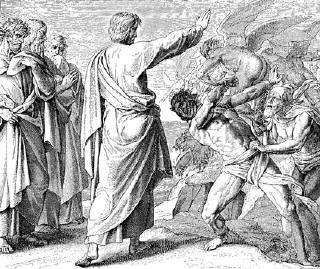


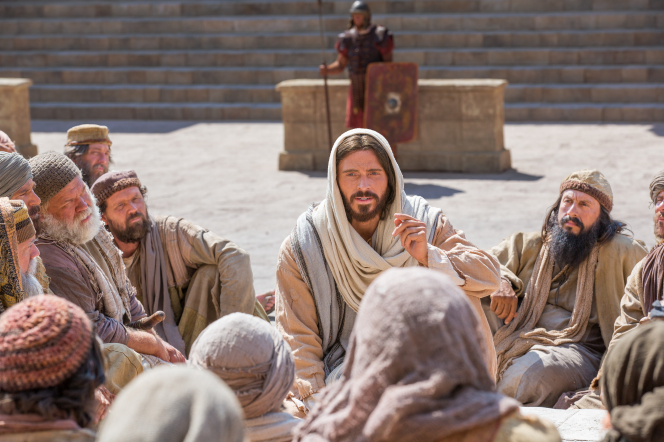
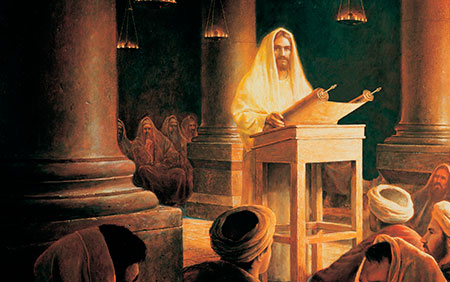
This passage, begins with Jesus, while passing through Capernaum, stopping in at the synagogue there and starting to teach.  This was not uncommon for travelling Rabbis.  But what had the people there somewhat more than startled was that he was giving his own teaching, his own interpretation of the Scriptures as if he had the authority and was ordained to do so.  It is pointed out that the revered "teachers of the law" did not have this authority and this left the people wondering by what authority or "certification" did he consider himself to have the right.

In Jewish society only those Rabbis who were ordained and recognized by the community as having s'mikhahto, or, "authority", were allowed to give their own interpretation of the law and Scripture in general.  All other teachers were expected to only recite existing accepted interpretations, commonly the "yoke", or interpretation and lifestyle passed on to them by the Rabbi who they had studied under and been a talmidim, or disciple of.  This was treated very seriously with Jesus' act being like someone today practising medicine without a medical license, or setting themselves up in a courtroom to decide legal cases without being appointed or elected.  Being recognized in the community as having s'mikhahto meant that a person was authorized to pass legal judgements and tell people how they should be living their lives, how they should be practising and living out their part of the Covenant with God. 

Recognition as a Rabbi with s'mikhahto was an involved process that can be thought of as similar to ordination or professional licensing in today's society.  In first century Galilee, this process started at age 4-5 in a Beth Sefer (elementary school) associated with the local synagogue and taught by a teacher hired by the community.  Teaching would focus on the Torah and the reading, writing, and memorizing of Scripture.  If you were considered one of the better students, one would continue one's study (while also learning a trade) at a Beth Midrash, also taught by a rabbi of the community.  There one would study the prophets and the writings, interpretations of the Oral Torah, and continue to memorize Scripture.  If one was one of the most outstanding students of the Beth Midrash, one might seek permission to study with a famous rabbi and leave home to travel with him for a period of time. After this, one might be considered by the Rabbi one studied with as a candidate for semicha, or rabbinic ordination. Semicha, literally, "laying of the hands", was a ritual that ensured that the student was the next link in the Sinaic tradition and authorized him to judge cases which involved any sort of punitive punishment. This ceremony had to be done by a Rabbi already ordained in this manner while accompanied by two others. The ceremony itself consisted of addressing the person as "rabbi" and telling him:  "You are ordained and you have the authority to render judgement, even in cases involving financial penalties".


https://www.thattheworldmayknow.com/rabbi-and-talmidim

http://www.chabad.org/library/article_cdo/aid/1933944/jewish/What-Is-a-Rabbi.htm

Given this information, you can imagine what a big deal it would be for Jesus, who was not certified in this manner, to start offering his own interpretation of Scripture and how people should live and act to fulfil the Covenant. The passage states that the people were, "amazed" that he was teaching with authority.  In the Greek, ἐξεπλήσσοντο (exeplēssonto).  Strong's Concordance defines this expression as: I am thunderstruck, astounded (1605 )

In Mark's story we immediately go from the people in the Synagogue being struck with shock and panic at finding Jesus to be claiming an authority he has not been licensed to hold to what seems to be a complete non-sequitur:
Just then a man in their synagogue who was possessed by an impure spirit cried out, 24 “What do you want with us, Jesus of Nazareth? Have you come to destroy us? I know who you are—the Holy One of God!”
A man possessed by a demon starts addressing Jesus and shouting at him.  However, when we look at what the impure spirit says, we realize it is not a non-sequitur at all, but an answer to the unspoken question from the previous verse, "Where does Jesus get his authority?  What gives him the right to give his own teaching and tell people how they should live their lives?".

The unclean spirit recognizes Jesus' identity as the, "Holy One of God", and appears fearful that Jesus will destroy him, conferring to him the authority and ability to perform this act on a being of the supernatural realm.  The implication is that beings of the supernatural realm recognize and vouch for his authority.  There is also an implication that those who are in touch with the supernatural, those who, "know God", would recognize Jesus authority and would recognize that his teaching is, "of God". 

So, why did the community of Mark tell this particular story about Jesus, in this particular way?  What did it mean to them?  Although it is believed that there was a Gentile portion of the community, the majority were most likely Jewish.  Whether the community was in one of the provinces of Palestine or somewhere in the diaspora, there would have been other Jews around who would question the way they chose to live.  They would ask why members of this community, if they claimed to be part of Judaism, did not follow an authorized and accepted interpretation of the law and Jewish practice.  Why did the community not follow the laws and practices the way they did?  How could they consider themselves legitimate Jews if they followed the yoke and teaching of an un-ordained, unrecognized Rabbi who operated outside of the chain of s'mikhahto passed down from one Rabbi to the next in the Sinaic tradition.

The  community's response through this story was that this authority came from supernatural recognition and appointment rather than tradition and the, "systems of man".  And that the truth of this could be found by those who "know God" recognizing his word rather than the dictates of tradition.


Saturday, 27 February 2016

Leaving Zebedee - Mark 1:19-20

19 When he had gone a little farther, he saw James son of Zebedee and his brother John in a boat, preparing their nets. 20 Without delay he called them, and they left their father Zebedee in the boat with the hired men and followed him.


In the previous verses, we heard about Jesus calling the fisherman brothers Simon and Andrew to be his talmidim (disciples).  In the verses above, Jesus travels a little further along the sea of Galilee and calls a second pair of brothers who are fishermen, James and John.  

Looking at the previous verses, we discussed how the Jesus of Mark considers himself as a Rabbi and teacher who had authority (Hebrew s'mikhahto) to interpret Scripture and had his own interpretation, or "yoke", to instruct to students.  He presented himself as this although no credentials are given that would allow him to claim this authority or position as would be expected in the Jewish community. So far in the narrative, Jesus has only had the revelation of God's favor during his baptism with John, spent a period of time in the wilderness, and then done some preaching in Galilee, spreading a message similar to that of John the Baptist.  This provoked the question of why the brothers would take up his offer to become his talmidim.

We also looked at the commitment expected of someone who became the talmidim of a Rabbi.  They were understood to follow the Rabbi in his travels, to submit to the Rabbi's interpretation of the Scriptures and its application to their lives, and to totally devote their time to becoming like their Rabbi.  It was assumed that they would spend their entire time listening to and observing the teacher to know how to understand the Scripture and how to put it into practice.

The one difference between the calling of Simon and Andrew in the previous verses and the calling of James and John in this passage, is the part with them immediately leaving their father behind.  In both incidents the following of Jesus is portrayed as an immediate, on the spot, action, where nets were dropped and all else left with no looking back.  Here their father is left still sitting in the fishing boat while they start trailing after Jesus down the beach with an implication that they said no goodbyes, or even stopped to discuss this decision with their father.  

It was not uncommon, for young men to leave their family and occupation to follow a Rabbi for a period of time if called.  However, in First Century Jewish Palestine, where Patriarchy and the family were the center of authority and allegiance, it is difficult to imagine one making this move without first being granted permission and receiving a blessing from one's father. Since the family was the primary economic unit, it would have been similar as well to asking for an extended leave from your employer.  It is possible that since their father was right there in the story when they are called that they received some sort of nod from him which is not mentioned.  But consider the brothers Simon and Andrew in the preceding verses, there is no mention of their father being on the scene when they drop everything and follow Jesus, and again nothing about swinging by home to ask permission or make arrangements.


That also brings up the question of Simon's wife.  The others may have been married as well, but the only one the Gospels make mention of is Simon who's wife's mother is healed of a high fever by Jesus later in the chapter.  Lois Tverberg, an author on the subject of Jesus as a Rabbi, states that:
A disciple had to ask his wife’s permission to be away from home to study longer than 30 days.  http://ourrabbijesus.com/2013/09/16/a-question-about-disciples-rabbis/
However, there is no mention of Simon doing this before or after accepting Jesus' call.

This introduces another aspect of Jesus' teaching as given in Mark and the other Gospels; it wasn't exactly pro-family.  In spite of a Western Cultural Christian spin that is almost unquestioned, the Christianity of Jesus is not family centered, or based on, "family values". There is a reason why no one quotes Jesus on Family Day.


It is not that Jesus was specifically anti-family; he was just against tribalism in general where it restricts universal and unbiased love. Jesus proclaimed social equality, inclusion, and the indiscriminate nature of God's love which he called us to imitate. As such, Jesus warned us against any cultural, national, or religious division that encourages people to prefer, favor, or give allegiance to some individuals or groups while discriminating against, discounting, or marginalizing others.

Jesus' most famous statements on this in terms of family are:
If anyone comes to me and does not hate father and mother, wife and children, brothers and sisters—yes, even their own life—such a person cannot be my disciple. (Luke 14:26 NIV)
Anyone who loves their father or mother more than me is not worthy of me; anyone who loves their son or daughter more than me is not worthy of me. (Matthew 10:37 NIV)
Hate in Hebrew doesn’t have the same connotation it does in the west. Hate in Hebrew is leesno whose root word is meeshno which means less important or second place.  For these passages, let me also point out that, for the Gospel writers, Jesus and, "The Way of Jesus", were synonymous and that Jesus' Way was a vision of a God of indiscriminate and unpreferential love. Seen from this perspective, Jesus was telling his followers not to love anyone any less than with the love normally reserved in their society for family members.

I would contend that Jesus' point was not that we should not love our family, but that our love should be universal and that his concern was that family devotion and obligation should not exclude those outside our family, that this same love and duty should extend beyond all social groupings whether it be family, religion, nationality, or social caste based on wealth and power.
Despite this, many conservative right-wing Christian denominations and groups peddle Christianity as being primarily about, "Family Values". This phrase and the term, "Pro-Family", have become code words to promote a doctrine that narrows the definition of family to exclude same sex couples and their children and that further defines family in patriarchal terms that enshrine unequal power relationships. It is interesting to note that the States in the U.S. where conservative Evangelicals who promote the ideology of "Christian Family Values" have the most sizable population also report the highest number of unplanned pregnancies and S.T.D.s as well as the highest rates of domestic abuse.

The book of Mark is the least, "Family Friendly", of the Gospels.  There is no backstory about his parents, no genealogy, no nativity narrative, and no stories about a young Jesus growing up and visiting the Temple with his family.  He just appears for his baptism with John as fully formed. 

I can imagine that there were many in the community of Mark who had left family behind to be part of this commune with some even disowned by their families.  There would also have been the destitute who had no family connections or support to speak of.  To these people, living in a society where family was the most important source of status, economic security, and support, a message that set family as secondary and of less importance than the Way they were following would be empowering and affirming.


Thursday, 25 February 2016

Calling Of Disciples - Mark 1:16-18


16 As Jesus walked beside the Sea of Galilee, he saw Simon and his brother Andrew casting a net into the lake, for they were fishermen. 17 “Come, follow me,” Jesus said, “and I will send you out to fish for people.” 18 At once they left their nets and followed him.

The next scene, after Jesus begins his ministry in Galilee proclaiming his message, has him choosing some disciples. The first thing this indicates is that the Jesus of Mark considers himself a Rabbi, a teacher who had authority (Hebrew s'mikhahto) to interpret Scripture and had his own interpretation, or "yoke", that he would instruct students, or disciples, in.

Most Rabbis, or "masters", were Torah teachers, "teachers of the law", as referred to in the Gospels, who could only teach accepted interpretations, mainly the interpretation, or "yoke", that their master had instructed, or passed on to them as their disciples. Those with 
s'mikhahto could make new interpretations, pass legal judgements, and could call their own talmidim (disciples) to learn and pass on their yoke. (https://www.thattheworldmayknow.com/rabbi-and-talmidim)

In Matthew 21:23-27, Jesus is questioned on his authority to interpret the law;  from which authority did he get his interpretation from, who was his teacher, or what qualified him as having his own authority?  The Gospels give him no credentials, no claims to have studied at any specific Beth Midrash, or to have been a talmidim and travelled with some famous Rabbi.  In fact, as we saw earlier, the writer of Mark makes some effort to discourage the idea he might have been a student or follower of John the Baptist.

This begs the question of why the brothers would drop their nets and follow him when he called.  This would have been a big commitment on their part and for someone who had no credentials.

Doug Greenwold, a Teaching Fellow at Preserving Bible Times, describes what was expected in becoming a Rabbi's disciple:
If a rabbi ultimately agreed to a would-be-disciple’s request, and allowed him to become a disciple, the disciple-to-be agreed to totally submit to the rabbi’s authority in all areas of interpreting the Scriptures for his life. This was a cultural given for all observant Jewish young men – something each truly wanted to do. As a result, each disciple came to a rabbinic relationship with a desire and a willingness to do just that - surrender to the authority of God’s Word as interpreted by his Rabbi’s view of Scripture.  https://bible.org/article/being-first-century-disciple

Ray Vander Laan, a teacher of Jewish culture who received his Master's of Divinity from Westminster Theological Seminary , explains it further:
The decision to follow a rabbi as a talmid meant total commitment in the first century as it does today. Since a talmid was totally devoted to becoming like the rabbi he would have spent his entire time listening and observing the teacher to know how to understand the Scripture and how to put it into practice. Jesus describes his relationship to his disciples in exactly this way (Matt. 10:24-25; Luke 6:40) He chose them to be with him (Mark 3:13-19) so they could be like him (John 13:15).  https://www.thattheworldmayknow.com/rabbi-and-talmidim


What also are we to make of Jesus' choice of talmidim? He calls two fishermen of Galilee.  Now, at the beginning of this study I stated that I wish to identify my own bias while interpreting this Gospel.  My bias would be to spin a narrative that sees the community of Mark portraying Jesus as deliberately choosing marginalized and uneducated as people and affirming them as eligible to follow his teaching and way of life.  This certainly would be in keeping with the theme throughout the Gospel of Jesus including and even preferring the marginalized.  However, Ray Vander Laan suggests that these assumptions about these fishermen may not hold true and that: 
The people of Galilee were the most religious Jews in the world in the time of Jesus. This is quite contrary to the common view that the Galileans were simple, uneducated peasants from an isolated area.
The Galilean people were actually more educated in the Bible and its application than most Jews. More famous Jewish teachers come from Galilee than anywhere else in the world. They were known for their great reverence for Scripture and the passionate desire to be faithful to it. This translated into vibrant religious communities, devoted to strong families, their country, whose synagogues echoed the debate and discussions about keeping the Torah
Be that as it may, what is important to this study is what view the people of the community of Mark held and how it informed their telling of their story of Jesus.  I have to conclude that they would share the prejudices of the Jews of the other provinces that we looked at in the previous post and saw Galilee as representing an unsophisticated and rural poor.

Most commonly a person would ask a Rabbi to take them on as a disciple rather than a Rabbi asking someone to follow them.  An article by Doug Trudell (whose credentials I can not find) suggests the type of criteria a Rabbi would use for a talmidin:
To make his decision, a rabbi would question you. He would seek to determine your scriptural knowledge. He would question you regarding the sages and the prophets and dig into your interpretation of the Scriptures and various laws. Ultimately the rabbi would be seeking to answer just one question. That is....Can this potential disciple, really become just like me, or putting it another way, can this potential talmid become a mirror image of me?Breaking that down, the rabbi was trying to determine if you could a) learn all of his teachings b) learn to think and act as he acted and c) could you then spread his “yoke” to others.  http://dougtrudell.com/html/i_choose_you.html
I can imagine that the community of Mark were affirming that becoming like Jesus was open to everyone.  The statement about sending the brother out to, "fish for people", would be a message within the community that all of them were eligible to spread Jesus' teaching and yoke.

I can also see the Gospel writer's lack of credentials for Jesus as a defiance of the monopoly "accredited" Rabbis had on interpreting Scripture in the Jewish world.  Jesus did not need credentials or a specialized education to claim authority and convince others to follow him and become his disciples. Neither did the community of Mark believe that they did.

I believe that the community of Mark held a view on authority for teaching similar to that latter expressed in the Gospel of John.
16 Jesus answered, “My teaching is not my own. It comes from the one who sent me. 17 Anyone who chooses to do the will of God will find out whether my teaching comes from God or whether I speak on my own." (John 7:16-17)
Jesus' lack of credentials also reinforced the narrative that his teaching was, "not of man, but of God".  Simon and Andrew's decision to become Jesus' talmidim when he had no credentials or recognized status would also speak to the idea that, as suggested in the passage above, that people who did thw will of God could recognize that his teaching came from God rather than his speaking on his own.


Wednesday, 24 February 2016

Proclaiming the Good News - Mark 1:14-15

14 After John was put in prison, Jesus went into Galilee, proclaiming the good news of God. 15 “The time has come,” he said. “The kingdom of God has come near. Repent and believe the good news!”

Jesus' ministry, after his baptism by John, begins with his proclaiming the, "good news of God", in Galilee.  Let's start with the, "where", and explore why the community of Mark may have had Jesus start his work in Galilee.
In the time of Jesus, Palestine was divided into three provinces, Judea, Samaria, and Galilee.  Galilee, particularly the northern portion, was home to a large Gentile population. The Upper Galilee included the whole mountain range lying between the upper Jordan and Phoenicia. To this region the name "Galilee of the Gentiles" is given in the Old and New Testaments. (Isaiah 9:1; Matthew 4:16)  http://biblehub.com/topical/g/galilee.htm

The 
ATS Bible Dictionary describes the view held of Galileans by the Jews of the other provinces:
...other Jews affected to consider them as not only stupid and unpolished, but also seditious, and therefore proper objects of contempt,Luke 13:1 23:6 John 1:47 7:52....Many of the apostles and first converts to Christianity were men of Galilee, Acts 1:11 2:7, as well as Christ himself; and the name Galilean was often given as an insult, both to him and his followers.
Starting Jesus' ministry in Galilee would suggest the priority placed on the marginalised and rejected.  The Jesus of the community of Mark does not hold the common biases and prejudices of the day and acts in opposition to them.

Now let's look at the, "what", of the message he preached.  His message was the good news that the time had come and the kingdom of God had come near.

The expected time he is talking about is the establishment of God's kingdom foretold in the book of Daniel.
“Then the sovereignty, power and greatness of the kingdoms under the whole heaven will be handed over to the saints, the people of the Most High. His kingdom will be an everlasting kingdom, and all rulers will worship and obey him” Daniel 7:27
The writings of the book of Daniel were quite important to the Jesus of Mark with him quite often referring to the figure of the, "son of man", from that book. But, the main reference is to the idea of the establishment of the Kingdom of God.

The presence and arrival of the Kingdom of God was the central message of Jesus in Mark and the other Synoptic Gospels, not his death, or some afterlife, or ones fate there.

The term "Kingdom of God" occurs four times in Matthew (12:28; 19:24; 21:31; 21:43), fourteen times in Mark, thirty-two times in Luke, twice in the Gospel of John (3:3, 5), six times in Acts, eight times in Paul, and once in Revelation(12:10). Matthew actually prefers the term "Kingdom of heaven" which he uses over 20 times in his gospel. http://www.theopedia.com/kingdom-of-god
We will take a closer look at what the Jesus of Mark's Gospel meant by the, "Kingdom of God", further into the study. For now, let's look at how Jesus' called the people to respond to his announcement that the, "Kingdom of God has come near".


"Repent and believe the good news!”


Let us first look at the word, "repent".

g3340   
μετανοέω
 
μετανοέω metanoéō, met-an-o-eh'-o; from G3326 andG3539; to think differently or afterwards, i.e. reconsider (morally, feel compunction):—repent. https://www.blueletterbible.org/lang/lexicon/lexicon.cfm?Strongs=G3340&t=NIV

The Greek word given as, "repent", in most English translations mean to, "think differently", or, "reconsider".  Jesus here is telling the people to, "think differently", in light of the news that the kingdom of God has come near.

He also preaches to the people that they should, "believe", in this good news, to put their trust in and give their allegiance to the implications of this news.