Friday, 5 June 2026

Out of a Person's Heart: Mark 7:1-23

The Pharisees and some of the teachers of the law who had come from Jerusalem gathered around Jesus 2 and saw some of his disciples eating food with hands that were defiled, that is, unwashed. 3 (The Pharisees and all the Jews do not eat unless they give their hands a ceremonial washing, holding to the tradition of the elders. 4 When they come from the marketplace they do not eat unless they wash. And they observe many other traditions, such as the washing of cups, pitchers and kettles.)

5 So the Pharisees and teachers of the law asked Jesus, “Why don’t your disciples live according to the tradition of the elders instead of eating their food with defiled hands?” 6 He replied, “Isaiah was right when he prophesied about you hypocrites; as it is written:

“‘These people honor me with their lips,

    but their hearts are far from me.7 They worship me in vain;

    their teachings are merely human rules.’

8 You have let go of the commands of God and are holding on to human traditions.”

9 And he continued, “You have a fine way of setting aside the commands of God in order to observe your own traditions! 10 For Moses said, ‘Honor your father and mother,’ and, ‘Anyone who curses their father or mother is to be put to death.’ 11 But you say that if anyone declares that what might have been used to help their father or mother is Corban (that is, devoted to God)— 12 then you no longer let them do anything for their father or mother. 13 Thus you nullify the word of God by your tradition that you have handed down. And you do many things like that.”

14 Again Jesus called the crowd to him and said, “Listen to me, everyone, and understand this. 15 Nothing outside a person can defile them by going into them. Rather, it is what comes out of a person that defiles them.” [16] 

17 After he had left the crowd and entered the house, his disciples asked him about this parable. 18 “Are you so dull?” he asked. “Don’t you see that nothing that enters a person from the outside can defile them? 19 For it doesn’t go into their heart but into their stomach, and then out of the body.” (In saying this, Jesus declared all foods clean.)

20 He went on: “What comes out of a person is what defiles them. 21 For it is from within, out of a person’s heart, that evil thoughts come—sexual immorality, theft, murder, 22 adultery, greed, malice, deceit, lewdness, envy, slander, arrogance and folly. 23 All these evils come from inside and defile a person.”


Our point of view is to look at this passage from the perspective of the author and the community they were writing for.  Our main question is why did they include this story about Jesus and why did they write it the way that they did.  What were they trying to say to each other?

I first notice that the customs of "the Jews" is spelled out as for an audience who is unfamiliar and so is probably mostly gentile. Next, I can imagine that this is a question that diaspora Jews in their wider community might ask them.  "Why, if you are followers of the teaching of a Jewish Rabbi, do you not observe the ritual cleaning and purification traditions of the Jewish elders?"  This codifies their answer in terms of what they see as one of the main tenants of Jesus teaching and how it is framed as being more faithful to the scriptural tradition of God requiring holiness and purity as part of the covenant, of being God's people.  


Jesus's teaching is one of spirit over law, the  purity/holiness/cleanliness of the inner life over outer rituals of purity and cleanliness. "For it is from within, out of a person’s heart, that evil thoughts come..."   The image of the heart as being the centre of 
a person’s psychological self, the source of thoughts, emotions, intentions, and behavior, is a powerful and longstanding metaphor found in ancient Egyptian and parts of Greek thought. It was also a familiar one from the Jewish scriptures.  The Tanakh uses the heart to represent the source of intentions and action in a number of places.  These include:

Genesis 6:5  “Every inclination of the thoughts of the human heart was only evil all the time.”
Proverbs 4:23  “Above all else, guard your heart, for everything you do flows from it.”
1 Samuel 16:7  “The Lord looks at the heart.”
Psalm 51:10  “Create in me a clean heart, O God…”
Proverbs 23:7  “For as he thinketh in his heart, so is he.”

In modern terms, the “heart” here represents the integrated psychological core; what today we might divide into:
Mind (thinking)
Emotion (feeling)
Will (choosing)
But in Hebrew anthropology, these are unified in the heart, making it the primary driver of human behavior.

In this teaching, the writer has Jesus identify with the Prophetic stream of the Tanakh where the Prophets reject outward ritual without an alignment of the peoples' hearts with the principles behind the law and ritual. These principles include, "doing good" in terms of social justice, kindness, compassion, and a lack of malice.

Examples Include:

"What need have I of all your sacrifices? Says the Lord… Bring no more vain offerings… Your new moons and that appointed seasons fill me with loathing… Though you pray at length, I will not listen… Learn to do good. Devote yourselves to justice; aid the wronged. Uphold the rights of the orphan; defend the cause of the widow."  Isaiah 1:11–17

 "I hate, I despise your festivals, and I take no delight in your solemn assemblies. Even though you offer me your burnt offerings and grain offerings, I will not accept them… Take away from me the noise of your songs; I will not listen to the melody of your harps. But let justice roll down like waters, and righteousness like an ever-flowing stream."  Amos 5:21–24

 "With what shall I approach the Lord, do homage to the God on high? Shall I approach Him with burnt offerings, with calves a year old? Will the Lord be pleased with thousands of rams, with myriads of streams of oil?… He has told you, O man, what is good, and what the Lord requires of you: Only to do justice, to love goodness, and to walk modestly with your God."   Micah 6:6–8 

"Thus said the Lord of Hosts: Render true judgments; show kindness and compassion to one another. Do not defraud the widow, the orphan, the stranger, or the poor; and do not plot evil against one another in your hearts." Zechariah 7:4–10

One aspect of this teaching which gives me pause is that by having Jesus identify the heart as the source of evil it seems the author is suggesting that humanity is basically corrupt or bad. 
Such an interpretation does not align with other teachings given of Jesus about the heart and its contents in some of the other Gospels.
“The good person out of the good treasure of his heart produces good, and the evil person out of his evil treasure produces evil… for out of the abundance of the heart his mouth speaks.” Luke 6:4

 “For out of the abundance of the heart the mouth speaks. The good man brings good things out of the good stored up in him…”  Matthew 12:34–35

As well, the Gospel of Mark also has Jesus say: “You shall love the Lord your God with all your heart…” Mark 12:30.  The authors would not have included this as Jesus's words if they thought that the human heart was only filled with evil and was basically corrupt.  If that was the case it would be impossible to love God with all one's heart.

Thursday, 21 May 2026

Walking on Water: Mark 6:45-56


45 Immediately Jesus made his disciples get into the boat and go on ahead of him to Bethsaida, while he dismissed the crowd. 46 After leaving them, he went up on a mountainside to pray.

47 Later that night, the boat was in the middle of the lake, and he was alone on land. 48 He saw the disciples straining at the oars, because the wind was against them. Shortly before dawn he went out to them, walking on the lake. He was about to pass by them, 49 but when they saw him walking on the lake, they thought he was a ghost. They cried out, 50 because they all saw him and were terrified.

Immediately he spoke to them and said, “Take courage! It is I. Don’t be afraid.” 51 Then he climbed into the boat with them, and the wind died down. They were completely amazed, 52 for they had not understood about the loaves; their hearts were hardened.

53 When they had crossed over, they landed at Gennesaret and anchored there. 54 As soon as they got out of the boat, people recognized Jesus. 55 They ran throughout that whole region and carried the sick on mats to wherever they heard he was. 56 And wherever he went—into villages, towns or countryside—they placed the sick in the marketplaces. They begged him to let them touch even the edge of his cloak, and all who touched it were healed.


In this passage there is the same allusion as the previous passage to Jesus being a new Moses.  Just as Moses parted the Red Sea allowing the Israelites to pass and rescuing them from their Egyptian oppressors, Jesus is able to command the waters and rescue the disciples in their boat from the winds.  There is the suggestion that the way of Jesus also rescues the people from oppression and brings order rather than chaos, creation rather than destruction.

Like the story of Jesus calming the storm in the fourth chapter of Mark, Jesus, or his Way, is again shown as bringing order and creation out of chaos, implying the divine nature of his teaching.  Again there is the allusion to the Hebrew creation story that starts with, "the spirit of God...hovering over the waters".  The creation of the world by the Hebrew god in this creation story is an act of order over chaos in deliberate contrast to the Babylonian creation story where creation is achieved through the violent death of the god Tiamat by the storm god Marduk where Tiamat's corpse is used to form heaven and earth.  As such, bodies of water and storms are seen to be the antithesis of the creative power of the Hebrew God, with Jesus ability to master these elements as tying into God's creative power, and alluding to the similar power of his teaching or 'Way'.

There are a couple of differences between this story and the earlier story that speak to Jesus's identity and equate Jesus with being like God.  The earlier story has the disciples ask the question "Who then is this, that even the wind and the sea obey him?".  This story uses a number of elements to answer that question.  In this story, Jesus goes from calming chaos to having dominion over it in a way only God was known to do.  In the scriptures walking on water is something only God can do.  Job 9:8 states, "He alone stretches out the heavens and treads on the waves of the sea".  As well, Psalm 77:19 states, "Your path led through the sea, your way through the mighty waters, though your footprints were not seen".

Another suggestion of Jesus's divinity is the reference to the "I AM" language of God in Jewish scripture.  Jesus says, "Take heart, it is I; do not be afraid" to the disciples.  As well, the story has the odd detail that "he was about to pass them".  This language is suggestive of the story in Exodus 33 and 1 Kings 19 where God "passes by". 

This story also furthers the theme Jesus's works revealing his identity and the disciples failure to understand who he is.  When they first see Jesus on the water, instead of recognizing him, they think he is a ghost.  The Gospel also adds that. "they had not understood about the loaves; their hearts were hardened".

Who is the Gospel revealing Jesus to be and how metaphorically did they intend this identity?  This story takes the identify beyond being a new Moses to someone who shares more similarities with God.  Do these references go beyond what was expected to cast Jesus as the Messiah, God's anointed one, someone with authority to speak on his behalf who would usher in God's new age?  Taken that in the first century a Rabbi and their teaching, their 'Way', were synonymous, did the writer and their audience take all these divine or semi-divine allusions as metaphors for Jesus' teaching?  Were they casting Jesus' Way as divine and analogous with God, that which is the epitome of truth and legitimacy?

I could be wrong, but I don't think the purpose of the Gospel was the revelation of Jesus identity as divine through gradual proofs by the telling of his great deeds.  I think that the divinity identity is a literary device to legitimize his Way as shown through his words and actions in the Gospel.  Let's look again at what that Way has been shown to be so far.

As we have observed in our study of the Gospel to this point, Jesus is given as starting his ministry preaching a continuation of the message of John the Baptist, telling the people to "repent", change their thinking and direction in terms of social justice; fairness, sharing with others, and caring for the disadvantaged. As the Gospel progresses the message includes:

  • Radical inclusion based on a vision of a primarily loving and compassionate God where all are welcome and equal participants in the people of God and no one is excluded or sanctioned. 
  • Social and religious restrictions and purity considerations are cast aside as the leper, the sick, the poor, and the outcast are made whole and welcomed back into full participation in community.   
  • Jesus eats with "sinners" lifting their status to be equal his own.  
  • Humanity has priority over rules and laws with spirit and love overruling legalism. 
  • Through parables Jesus shows the need to turn our cultural assumptions and understandings upside down and see the world from a new perspective.  Jesus gives no rules or practices with his teaching consisting almost entirely on parables, shifting one's perspective and reflection through metaphor.
  • The "kingdom of God", the incidence of what is most true and right, increases in the world from small acts like "tiny seeds".


Friday, 15 May 2026

Jesus, a Moses Feeding the People: Mark 6:30-44

 30 The apostles gathered around Jesus and reported to him all they had done and taught. 31 Then, because so many people were coming and going that they did not even have a chance to eat, he said to them, “Come with me by yourselves to a quiet place and get some rest.”

32 So they went away by themselves in a boat to a solitary place. 33 But many who saw them leaving recognized them and ran on foot from all the towns and got there ahead of them. 34 When Jesus landed and saw a large crowd, he had compassion on them, because they were like sheep without a shepherd. So he began teaching them many things.

35 By this time it was late in the day, so his disciples came to him. “This is a remote place,” they said, “and it’s already very late. 36 Send the people away so that they can go to the surrounding countryside and villages and buy themselves something to eat.”

37 But he answered, “You give them something to eat.”

They said to him, “That would take more than half a year’s wages[e]! Are we to go and spend that much on bread and give it to them to eat?”

38 “How many loaves do you have?” he asked. “Go and see.”

When they found out, they said, “Five—and two fish.”

39 Then Jesus directed them to have all the people sit down in groups on the green grass.  40 So they sat down in groups of hundreds and fifties. 

41 Taking the five loaves and the two fish and looking up to heaven, he gave thanks and broke the loaves. Then he gave them to his disciples to distribute to the people. He also divided the two fish among them all. 42 They all ate and were satisfied, 43 and the disciples picked up twelve basketfuls of broken pieces of bread and fish. 44 The number of the men who had eaten was five thousand.


The parallel between this story and that in Exodus Chapter 16 of Moses and of God's provision of manna and quail to the Israelite community in the wilderness is obvious.  Jesus, his Way, is a new Moses and is shown to have the same endorsement from God making his teachings as legitimate as the law of Moses.  There are also a number of possible metaphorical meanings for which it is difficult to know which the community of Mark intended.  

Jesus's Way:

  • "Feeds", brings life and strength, to those who search after it and will "satisfy"
  • Is one of generosity and abundance where you end up with more than you started
  • Is egalitarian.  It makes all equally part of the community and welcome to be part of the sacred.  None are unworthy or excluded.
The last point comes from the part of the story where Jesus gave thanks, broke the bread and had his disciples distribute it to the people.  It was the custom in first century Jewish homes for the father or host who presided over the meal to dedicate it to God, to make it a spiritual event by offering a blessing on behalf of everyone present and by distributing pieces of bread broken as part of the blessing to those present.   In the first century it would have been a big deal to do this in front of a crowd since "table politics" meant that a person only ate with their social equals.  To eat with someone of lower status was to raise their status to that of your own.  Jesus equalizes and lifts the status of a crowd of five thousand, many of whom would have been considered on the margins, inviting them into his spiritual practice with no requirements or prejudice.

Another part of the story that stands out is how it works to show how "popular" Jesus is.  He has to try to get away to solitary places because there is always a crowd looking for him, and, when he finds what is supposed to be a solitary place, a crowd of five thousand men (how many more women and children?) gather.  Since, unlike John the Baptist, no mention of Jesus shows up in the official historical records of the time, I believe the writer is compensating for how little recognition Jesus actually had wherever the community that wrote this Gospel were situated.


Wednesday, 13 May 2026

John the Baptist Raised from the Dead Mark 6:14-29


14 King Herod heard about this, for Jesus’ name had become well known. Some were saying,[b] “John the Baptist has been raised from the dead, and that is why miraculous powers are at work in him.”

15 Others said, “He is Elijah.”

And still others claimed, “He is a prophet, like one of the prophets of long ago.”

16 But when Herod heard this, he said, “John, whom I beheaded, has been raised from the dead!”

17 For Herod himself had given orders to have John arrested, and he had him bound and put in prison. He did this because of Herodias, his brother Philip’s wife, whom he had married. 18 For John had been saying to Herod, “It is not lawful for you to have your brother’s wife.” 19 So Herodias nursed a grudge against John and wanted to kill him. But she was not able to, 20 because Herod feared John and protected him, knowing him to be a righteous and holy man. When Herod heard John, he was greatly puzzled[c]; yet he liked to listen to him.

21 Finally the opportune time came. On his birthday Herod gave a banquet for his high officials and military commanders and the leading men of Galilee. 22 When the daughter of[d] Herodias came in and danced, she pleased Herod and his dinner guests.

The king said to the girl, “Ask me for anything you want, and I’ll give it to you.” 23 And he promised her with an oath, “Whatever you ask I will give you, up to half my kingdom.”

24 She went out and said to her mother, “What shall I ask for?”

“The head of John the Baptist,” she answered.

25 At once the girl hurried in to the king with the request: “I want you to give me right now the head of John the Baptist on a platter.”

26 The king was greatly distressed, but because of his oaths and his dinner guests, he did not want to refuse her. 27 So he immediately sent an executioner with orders to bring John’s head. The man went, beheaded John in the prison, 28 and brought back his head on a platter. He presented it to the girl, and she gave it to her mother. 29 On hearing of this, John’s disciples came and took his body and laid it in a tomb.


This is somewhat of a non sequitur and self contained little story in the narrative of Jesus' biography.  Why is this important to the Jesus story to the gospel's community, and why place the story at this point?  

At the very beginning of the Gospel, John the Baptist was introduced as a character who endorses and legitimizes the figure of Jesus where the writer has John testify to Jesus' superiority and casts John in the role of messenger or herald.  We looked at how this endorsement suggested that John was a much more well known figure of the times and had a reputation for holiness and as a Prophet.  This is borne out by the fact that only the Gospels and Epistles mention Jesus while there is no trace him in any of the official historical records of the time unlike John the Baptist who is recorded by the Jewish Historian Flavius in this time period.  

This story again works to legitimize Jesus by comparisons with John the Baptist.  The writer has King Herod testify that Jesus must be John the Baptist "raised from the dead".  In fact this section of the story begins with testimonies from "others" about Jesus' standing as a religious figure, that "He is Elijah", and "a prophet".  It is at this point the testimony of Herod is repeated with, "John, whom I beheaded, has been raised from the dead".  The rest of the section seems to be an explanation about the circumstances of the beheading that Herod references, and as I said almost seems to be an aside and divergence from the main story.

However, rather than strictly an aside, I believe this story had a purpose in its inclusion. It think this story meant to foreshadow and legitimize the later story of Jesus' conflict with the authorities and cast it as being indicative of a prophet.  The references to Jesus being Elijah could serve the same purpose as this prophet was also known for his conflict with authority.

Another piece of foreshadowing and statement on Jesus' exceptional nature is the part of the story about Jesus being mistaken for John the Baptist, "raised from the dead".  It serves to underline that John, although recognized by the people as a prophet, was never raised from the dead, alluding to Jesus superiority as a spiritual figure through his resurrection.


Tuesday, 12 May 2026

Sending out the Twelve Mark 6:7-13


Then Jesus went around teaching from village to village. 7 Calling the Twelve to him, he began to send them out two by two and gave them authority over impure spirits.

8 These were his instructions: “Take nothing for the journey except a staff—no bread, no bag, no money in your belts. 9 Wear sandals but not an extra shirt. 10 Whenever you enter a house, stay there until you leave that town. 11 And if any place will not welcome you or listen to you, leave that place and shake the dust off your feet as a testimony against them.”

12 They went out and preached that people should repent. 13 They drove out many demons and anointed many sick people with oil and healed them.

What I find significant in this passage is that it shows that the community of Mark did not see Jesus' way as exclusive to him, but something that those who followed him could perform with the same authority and results.  This reminds me of the Gospel of Thomas, the twin, with the theme that we can become a twin of Jesus and partake in his enlightenment.

I also notice that this passage contains a distillation of Jesus 'Way', his teaching and 'way of seeing the world' which he commissions others to spread.  I would list this summary of Jesus Way as follows:

  • Authority over impure spirts
    • Jesus' Way primary involves the authority to welcome/facilitate those who are marginalized, considered "impure" or "unclean", into community, removing the barriers and performance factors the culture requires.  To drive out "impure spirits" is to remove conditions that keeps people from fellowship with God and community.  
  • Healing the sick
    • The Way of Jesus brings people into wholeness.  Metaphorically Jesus teaching is  seen dualistically as health rather than sickness.  Again this is an example of enabling everyone to be part of the community since the sick were also marginalized and excluded from Temple worship.
  • Lack of concern of material needs
    • Anti materialism is central to Jesus' teaching.  The world view of Jesus is one of abundance where needs will be provided and the Universe is profoundly generous. One needs not dwell on one's survival or fear scarcity, but can focus on what is more important.
  • The inherent generosity of humanity
    • Along with seeing the universe as generous and carrying, Jesus sees much of humanity as in the same light.  He has no fear that the twelve will find those who will welcome them, take them in, and supply for all their needs.  
    • Those who are not welcoming and generous to the disciples are seen as who are truly "impure".  The disciples are told to "shake the dust off" their feet, a practice by Pious 1st-century Jews traveling home from Gentile lands.  They would shake off the dust of those foreign nations to avoid bringing foreign, "unclean" dirt into the holy land.  
  • A message of repentance as a return to the social contract as given by the Prophets.
    • Jesus in the last passage identifies himself as a Prophet and the Prophet's were spokespeople for God telling the people to return, not to worship, not to greater adherence to purity laws and rituals, but to social justice in terms of caring for each other, providing for the poor and widowed, justice, mercy, and humility. 
    • Repentance is defined by John the Baptist in the third chapter of Luke as fulfilling social justice, “Anyone who has two shirts should share with the one who has none, and anyone who has food should do the same.”


Wednesday, 29 April 2026

Hometown Prophet Mark 6:1-4

 Jesus left there and went to his hometown, accompanied by his disciples. When the Sabbath came, he began to teach in the synagogue, and many who heard him were amazed.
“Where did this man get these things?” they asked. “What’s this wisdom that has been given him? What are these remarkable miracles he is performing? Isn’t this the carpenter? Isn’t this Mary’s son and the brother of James, Joseph,[a] Judas and Simon? Aren’t his sisters here with us?” And they took offense at him.
Jesus said to them, “A prophet is not without honor except in his own town, among his relatives and in his own home.” He could not do any miracles there, except lay his hands on a few sick people and heal them. He was amazed at their lack of faith.

For the community who assembled the Gospel of Mark, this story seems to touch a question I can imagine they would be often be asked by those who followed more mainstream Judaism in  whatever part of the diaspora they would have lived.  "Why have we not heard of this Jesus that you follow?"  This would be a legitimate question as the historical records of the time although they reference John the Baptist, hold not a single reference to Yeshua Ha Nozri, Jesus of Nazareth, other than the Gospels.  He just wasn't that well known or consequential a figure. 

It also addresses an issue around the authority of Jesus' teaching in that community.  The stories in the Gospel of Mark have to this point based the authority and legitimacy of the teachings of this un-ordained Rabbi on him being a Chasidium, a Rabbi who can dispense the mercy of God in terms of miracles.  The more dramatic Jesus' ability to call on God's power, the more credible his teaching.  The people in Jesus' hometown in the story express how they know his origins, his family, and trade.  They know he doesn't have the background, credentials and pedigree to be able to give his own teaching.  Everything depends on the validating miracles, and that is seen as limited here.

I can imagine sceptics asking this Jesus assembly sect why they can't perform similar miracles to validate the truth of their claims about Jesus' teachings.  Here's where the catch 22 introduced in this story comes in.  Jesus' miracle power is limited by the people's lack of honour and faith in him.  So, you can only get the miracles that would validate having faith if you already have that faith without validation in the first place.

So, what would "faith" that would merit the bestowing of God's miracle working mercy mean to this community?  And how metaphorically was this community speaking in terms of the mercies of God dispensed through the miracles of Jesus?  If we look at the last group of miracles in the Gospel, the calming of the storm can be interpreted as the teachings of Jesus bring order out of chaos, the exorcism of the legion as his teaching removing that which would make them unclean without priestly ritual, likewise the woman with the flow of blood, and the raising of Jairus' daughter could be seen as the new life and wholeness brought by his teaching.  So, then, what is the "faith" required to access the benefits of Jesus' teachings?  

The Greek word translated here as "lack of faith" is ἀπιστία or apistia meaning disbelief or unfaithfulness.  Although disbelief in Jesus' authority as a teacher and ability as a miracle worker would seem to be the obvious use, I think that the interpretation of the word as "faithlessness" in terms of being disloyal, or breaching a promise, might shed some light.  The story has Jesus identify himself as a prophet, "a prophet is not without honour...".  Several Old Testament prophets, most notably Hosea, Jeremiah, Amos, and Elijah, preached against Israel’s unfaithfulness, characterizing it as spiritual adultery, idolatry, and covenant violation. They warned of divine judgment and impending exile, while often calling for repentance and highlighting God's enduring love despite the nation's betrayal.  

I am going to posit that the authors of Mark are suggesting that those who are faithful in heart to their relationship with God are able to "hear" Jesus' teachings as truth and access the benefits.  The Gospel talks about this earlier when Jesus tells his disciples that "the secret of the kingdom of God" is given to them, while those "outside" hear everything in parables, seeing but not perceiving.  The Gospel also talks about the need for spiritual ears. Jesus frequently in this Gospel states that, "Whoever has ears to hear, let them hear".  So, looked at this way, the people of Nazareth did not have the faithfulness of heart to look past the familiar and recognize the spiritual authority of Jesus' "amazing" teachings and would not have received the benefits. 


Friday, 17 April 2026

A Girl Restored to Life Mark 5:21-43


21 When Jesus had crossed again in the boat to the other side, a great crowd gathered around him, and he was by the sea. 22 Then one of the leaders of the synagogue, named Jairus, came and, when he saw him, fell at his feet 23 and pleaded with him repeatedly, “My little daughter is at the point of death. Come and lay your hands on her, so that she may be made well and live.” 24 So he went with him.

And a large crowd followed him and pressed in on him. 25 Now there was a woman who had been suffering from a flow of blood for twelve years. 26 She had endured much under many physicians and had spent all that she had, and she was no better but rather grew worse. 27 She had heard about Jesus and came up behind him in the crowd and touched his cloak, 28 for she said, “If I but touch his cloak, I will be made well.” 29 Immediately her flow of blood stopped, and she felt in her body that she was healed of her disease. 30 Immediately aware that power had gone forth from him, Jesus turned about in the crowd and said, “Who touched my cloak?” 31 And his disciples said to him, “You see the crowd pressing in on you; how can you say, ‘Who touched me?’ ” 32 He looked all around to see who had done it. 33 But the woman, knowing what had happened to her, came in fear and trembling, fell down before him, and told him the whole truth. 34 He said to her, “Daughter, your faith has made you well; go in peace, and be healed of your disease.”

35 While he was still speaking, some people came from the synagogue leader’s house to say, “Your daughter is dead. Why trouble the teacher any further?” 36 But overhearing[g] what they said, Jesus said to the synagogue leader, “Do not be afraid; only believe.” 37 He allowed no one to follow him except Peter, James, and John, the brother of James. 38 When they came to the synagogue leader’s house, he saw a commotion, people weeping and wailing loudly. 39 When he had entered, he said to them, “Why do you make a commotion and weep? The child is not dead but sleeping.” 40 And they laughed at him. Then he put them all outside and took the child’s father and mother and those who were with him and went in where the child was. 41 Taking her by the hand, he said to her, “Talitha koum,” which means, “Little girl, get up!” 42 And immediately the girl stood up and began to walk about (she was twelve years of age). At this they were overcome with amazement. 43 He strictly ordered them that no one should know this and told them to give her something to eat.


In this passage we have a third and fourth miracle after the preceding section of Jesus' teachings that would have attested to their authority and legitimacy. The miracle of healing the woman suffering from a flow of blood, like the exorcism of legion, symbolically shows Jesus (and his Way) as doing away with impurity, making the unclean clean, and eliminating barriers to God and the community without the need for Temple rituals.  This would be an important theme for Jewish followers in this community living in the diaspora after the destruction of the Temple.

Under Second Temple Judaism, menstruating women (niddah) were seen as a source of ritual impurity (tum'ah) that could be transferred through physical contact with people, clothing, or even furniture.  As such a woman who was "suffering from a flow of blood" would be subject to social distancing and strict prohibitions such as being restricted from approaching the Temple.  For the woman to touch Jesus' cloak would have transferred ritual impurity to him.  However, like touching a leper to heal him earlier, the story shows Jesus unconcerned with ritual impurity.  In both cases, Jesus shows ritual impurity to be no barrier to God's mercy and shows his care for those ostracized and marginalized by the community, and brings them both back into full membership of the community.  Looked at symbolically, the Way of Jesus has concern for the marginalized and makes them equal parts of the community.

Another element to this story is the generation of life.  As long as this woman was menstruating she was prohibited from sexual intercourse and would have been unable to conceive a child.  Symbolically then Jesus' Way removes barriers to new life.

Next in the story we have the resurrection of Jairus' daughter.  This story is quite similar to one attributed to Rabbi Hanina ben Dosa, a Galilean holy man active in the mid-late first century.  Several Talmudic traditions describe Hannina as being summoned when a child is gravely ill, near the point of death rather than dead like in the story about Jesus.  Like the story here, there is a desperate family, an authoritative holy man, a confident declaration before physical evidence, and the instant reversal of a death like state.  Some scholars note that traditions such as this show that miracle-working holy men were an accepted category within first-century Judaism.  As mentioned in an earlier post, Apollonius of Tyana, a first‑century Greek philosopher and holy man, was explicitly reported in an ancient source to have brought a young person back from death.  So, the literary tradition of holy men bringing children back to life was also established in the wider Hellenistic world.  That given, I think that instead of looking at this story as factual we need to see the writer as having cast Jesus within a known literary genre in order to say something about Jesus and his Way, that Jesus has the same authority and legitimacy as these other known holy men.

This story also echoes stories of Elijah and Elisha.  Elijah revies the son of the widow of Zarephath in 1 Kings 17, and Elisha revives the son of the Shunammite woman in 2 Kings 4.  The writer may well have been alluding that Jesus is a prophet like Elijah and Elisha and has similar legitimacy and message from God.  This fits well with the writer having Jesus primarily refer to himself as the "Son of Man" which is the name God uses for the prophet Ezekiel.

Getting back to the reference to the prophet Elijah, he was a confrontational prophet whose life itself was his message.  His core message was around Israel's covenant with Yahweh being an exclusive allegiance and that Israel's worship of Baal was a breach of covenant for which he announced a drought as judgement.  Jesus, is cast as a new Elijah, who like him confronts the nation for it's failure to meet the spirit of the covenant.  

Elisha, on the other hand, emphasized Yahweh as the power that brings healing and restores what is broken where his power brings life, abundance, and renewal.  The writer may well have been alluding that the Way of Jesus similarly brings these things.

What is the teaching or 'Way' that the text has been working so hard to say makes Jesus like the prophets and holy men and that is legitimized by God doing the greatest of miracles through him?  As we've seen in earlier chapters it centers around accounts of Jesus ignoring social barriers and purity standards to bring all, including the most marginalized, into community, where those who were ostracized due to physical deformity or illness or failure to follow religious/social law and custom (tax collectors and sinners) have their barriers to inclusion removed.  It also involves making the circle of tribe ever larger, bigger than family, where "Whoever does God's will is my brother and sister and mother".   This is the Way the writer has Jesus epitomize after announcing the kingdom of God has come near and calls for the people to repent, to change direction.  This is the new direction.  This is the "good news", that everyone is included.

.


Thursday, 26 March 2026

Legion Mark 5:1-20


5 They came to the other side of the sea, to the region of the Gerasenes.[a] 2 And when he had stepped out of the boat, immediately a man from the tombs with an unclean spirit met him. 3 He lived among the tombs, and no one could restrain him any more, even with a chain, 4 for he had often been restrained with shackles and chains, but the chains he wrenched apart, and the shackles he broke in pieces, and no one had the strength to subdue him. 5 Night and day among the tombs and on the mountains he was always howling and bruising himself with stones. 6 When he saw Jesus from a distance, he ran and bowed down before him, 7 and he shouted at the top of his voice, “What have you to do with me, Jesus, Son of the Most High God? I adjure you by God, do not torment me.” 8 For he had said to him, “Come out of the man, you unclean spirit!” 9 Then Jesus[b] asked him, “What is your name?” He replied, “My name is Legion, for we are many.” 10 He begged him earnestly not to send them out of the region. 11 Now there on the hillside a great herd of swine was feeding, 12 and the unclean spirits[c] begged him, “Send us into the swine; let us enter them.” 13 So he gave them permission. And the unclean spirits came out and entered the swine, and the herd, numbering about two thousand, stampeded down the steep bank into the sea and were drowned in the sea.

14 The swineherds ran off and told it in the city and in the country. Then people came to see what it was that had happened. 15 They came to Jesus and saw the man possessed by demons sitting there, clothed and in his right mind, the very man who had had the legion, and they became frightened. 16 Those who had seen what had happened to the man possessed by demons and to the swine reported it. 17 Then they began to beg Jesus[d] to leave their neighborhood. 18 As he was getting into the boat, the man who had been possessed by demons begged him that he might be with him. 19 But Jesus[e] refused and said to him, “Go home to your own people, and tell them how much the Lord has done for you and what mercy he has shown you.” 20 And he went away and began to proclaim in the Decapolis how much Jesus had done for him, and everyone was amazed.


The story of Jesus healing a man with an unclean spirit that turned out to be "Legion" is the second of three "mighty deeds" or "miracles" that Jesus performs in Mark subsequent to a section on Jesus' teachings in order to legitimize his teachings and to give them authority.  There is a lot we can unpack here, but I am going to start by reminding myself of the audience of this story and look at some of the context.  

As explored in earlier posts, the author of Mark is writing for a mainly gentile audience in Greek (at least the earliest copies are in Greek) as part of a community that some have suggested may have been in Rome (Mark uses a number of Latin terms), Galilee, Antioch (third-largest city in the Roman Empire, located in northern Syria), or southern Syriathat.  Wherever the community resided in the Roman empire it was part of a world shaped by Hellenistic culture.  Written around 60 CE, this would put it at the time of the destruction of the Temple by the Romans and most certainly amongst the Jewish revolt.

There is a Greek pagan connection to the audience by the setting of the story being in Gerasa in the region of the Sea of Galilee, one of the "ten cities of the Decapolis of the province of Syria.  The people of the region were mainly Macedonian/Greek settlers of the Seleucid period who had adopted Greek culture and with a smaller number of Jews, mostly traders and artisans, but not culturally dominant.  Following the Greco-Roman worldview, their local spirits, or Daimones, were intermediate beings between gods and humans.  These Daimones could be protective, neutral, or malevolent and were blamed for illness, madness, and misfortune.  Local spirits were believed to be tied to land and city boundaries and to inhabit tombs, ruins, and caves.  Because of this tombs were feared and exorcisms and protective rituals were common. The story in Mark fits this description of the local Greco-Roman belief about spirits to a tee. In the Mark story the possessed man lives among the tombs and the unclean spirits beg Jesus not to send them out of the region, suggesting that they are tied to the land.

An exorcism as a mighty deed legitimizing a teacher's authority also fits Greek custom as a rhetorical device and would be familiar to the Gospel's Hellenistic audience as would the earlier miracle of calming the storm.   Mighty deeds, signs, and supernatural insight were sometimes portrayed as confirming a philosopher’s closeness to divine wisdom (theios anēr, “divine man”).  Pythagoras was said to have been able to calm storms and control natural forces as in Jesus' earlier miracle.  Apollonius of Tyana, a first century CE philosopher and wonder-worker was claimed to heal the sick, exorcise demons, and to have raised a girl from the dead (Jesus' next miracle).

I notice elements of the story referring to that which is "pagan", or "unclean", outside the Jewish system of holiness and purity laws and rules that were intended to provide access to God.  The possessed man lived among tombs which were considered ritually unclean in Second Temple Judaism.  They were considered unclean because death represents the strongest contradiction to the holiness of the Temple which embodies life and God's presence.  Numbers 19:11 states that, "Whoever touches a dead person...shall be unclean seven days".  This meant that a person could not enter the Temple, the site of the presence of God for seven days. This was extended to contact with graves as the impurity of death was seen as so powerful that it transmits through enclosed spaces (Num 19:14) .  Tombs were seen as permanent sources of impurity and were whitewashed before pilgrimage festivals to guard against accidental defilement.

The possessing spirits are also labeled as "unclean" in the story and would have been seen as representing the foreignness and idolatry of the Greek and Roman culture and local gods tied to the land and the people of this region.  This is further reinforced by the spirits naming themselves "Legion' referencing both the idea that they were many and powerful, and alluding to the foreign Roman occupiers. 

We also have the herd of swine which as a ritually unclean food became a powerful symbolic and cultural boundary marker in this period.  Pigs were religiously charged above the other unclean animals due to Antiochus IV Epiphanes (167 BCE) enforcing pig sacrifice and consumption as a loyalty test.

Given this background, I would suggest that for Gentile members of the community of Mark who we believe lived in a predominately Hellenistic community under Roman rule and the expectation of public religious participation in honoring Roman gods, this story would be seen symbolically as Jesus's, or the way of Jesus's, predominance and power over Rome and Hellenistic culture.  I can also see this as being interpreted as Jesus's way removing barriers to God and being a conduit to God that supplants the ritual holiness and purity laws.  Jesus is shown to have both done away with the impurity of the powerful hoard of spirits that made the possessed man impure and made him dwell in tombs that made him unclean and ineligible to be in God's presence, he also removed the herd of pigs, a huge herd of 2,000, that were a source of uncleanness and a symbol of foreign rule that demands loyalty to Caesar over God.  I would believe the inference here would be that the Way of Jesus for accessing God for these Gentile followers makes removes that which make them "unclean" or a barrier to God's presence, does not demand observance to the Jewish purity laws, and is not defiled or defeated by the pagan practices of the society, "the spirits of the land" in which they live.


Tuesday, 24 March 2026

Jesus Calms the Storm: Mark 4:35-41


35 That day when evening came, he said to his disciples, “Let us go over to the other side.” 36 Leaving the crowd behind, they took him along, just as he was, in the boat. There were also other boats with him. 37 A furious squall came up, and the waves broke over the boat, so that it was nearly swamped. 38 Jesus was in the stern, sleeping on a cushion. The disciples woke him and said to him, “Teacher, don’t you care if we drown?”

39 He got up, rebuked the wind and said to the waves, “Quiet! Be still!” Then the wind died down and it was completely calm.

40 He said to his disciples, “Why are you so afraid? Do you still have no faith?”

41 They were terrified and asked each other, “Who is this? Even the wind and the waves obey him!”


This story about Jesus calming the storm comes at the end of the fourth Chapter of Mark after a series of teachings and parables about the kingdom of God.  The first thing that comes to mind is that this story's purpose was to legitimize the previous teachings.  Jesus had no recognized right by the Jewish religious authorities to offer his own teaching, his own Mishnah, or interpretation of Scripture. Not having been certified by semicha, rabbinic ordination, Jesus did not have, s'mikhahto, "authority". The writer's claim to the legitimacy and authority of Jesus' teaching rests on him being a Chasidium, a Rabbi who can dispense the mercy of God.  The more dramatic Jesus' ability to call on God's power, the more credible his teaching.  As we've discussed before, establishing the credibility of the founder of their sect would have likely been important to the community of Mark living after the destruction of the Temple when a number of Jewish sects would have been vying to become the successor to Temple Judaism.  It was also likely that the community of Mark were part of the Jewish diaspora, most likely Rome, Antioch, or southern Syria.  As such, they would be under pressure from the rest of the Jewish expat community to conform to orthodoxy and would have to justify these unusual teachings.
This story also has allusions to the creation story where God brings order out of chaos with the story beginning with “Darkness ...over the face of the deep, and the spirit of God...hovering over the waters".  This part of the creation story was a response to the Babylonian creation story where the storm god Marduk slays the god Tiamat and uses her corpse to form heaven and earth.  In the Babylonian story chaos is divine and creation is achieved through violence while in the Hebrew story God calms and orders chaos through the power of God's word.  
Storms and seas are ongoing symbols of disorder and forces that resist life in the Hebrew Bible.  The Flood story of Genesis is described as a reversal of creation.  Psalm 89:9 states, "You rule the raging sea when its waves rise, you still them".  In Job, the Leviathan, a sea monster that embodies chaos itself, is created and defeated by God.
So, the story of Jesus calming the storm, right after a series of teachings and parables, serves to characterize Jesus' teachings as countering chaos and bringing order and life.  This fits nicely with other Gospel writings where the 'way' of Jesus is characterized as the positive side of a series of dualisms, the straight path as opposed to the crooked, light rather than darkness, heath instead of sickness, sight in contrast to blindness. 
The creative power of Jesus' teachings is also alluded to by the element of the story that the wind and waters are subject to his word.  This references the Creation story where God creates all things by speaking.  Thus Jesus' word, in the form of his teachings, is also being claimed to have a divine creative power.
In this story, Jesus, or Jesus' way, is like God in that it has power over and defeats the "gods" and "Leviathans" of chaos and the "floods" that threaten creation and life. It is part of God's Creation power, providing creation, order, life.
The other allusion that would have been top of mind to this community of mainly Jews would be to Moses and his parting of the Red Sea.  In a great demonstration of God's favour, Moses parts the Red Sea to allow the Hebrews to escape the pursuing Egyptian army.  Here Jesus is a new Moses, one who brings a new way from God and that rescues his people from both the chaos and death of the sea, and from the power and oppression of Empire which in this time would be Rome.


Sunday, 18 September 2016

Like a Mustard Seed - Mark 4:30-34


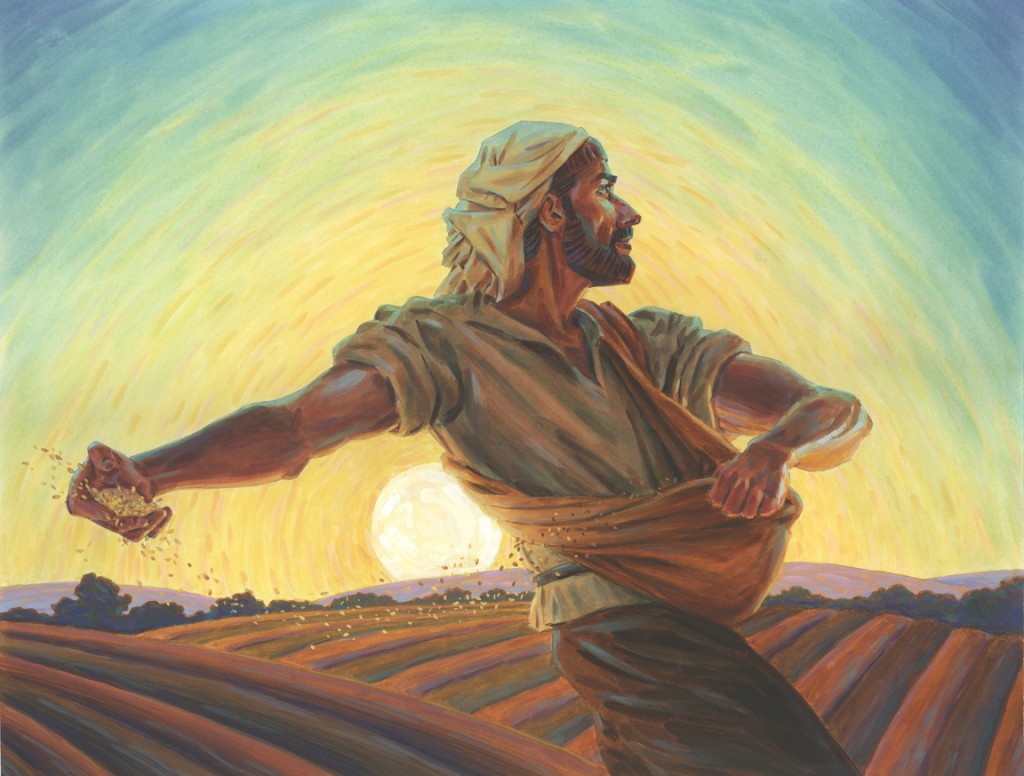
30 Again he said, “What shall we say the kingdom of God is like, or what parable shall we use to describe it? 31 It is like a mustard seed, which is the smallest of all seeds on earth. 32 Yet when planted, it grows and becomes the largest of all garden plants, with such big branches that the birds can perch in its shade.”

33 With many similar parables Jesus spoke the word to them, as much as they could understand. 34 He did not say anything to them without using a parable. But when he was alone with his own disciples, he explained everything.


The sayings of Jesus given in the Gospels include a number of parables and similes about, "the kingdom of God".  The entire fourth chapter of Mark centres on this theme.  While interpreting the meaning of the first parable, The Sower, Jesus tells his disciples that, "The secret of the kingdom of God has been given to you".  The passage previous compares the kingdom to a man scattering seed.  And, we can assume that the saying in between about the lamp on a stand is also a metaphor for the kingdom.

In an earlier post I discussed what the phrase, "the kingdom of God", would have implied to a Jewish audience of that period.  For some of them, the phrase would be identified in eschatological terms relating to the expected "new age". Jewish eschatological doctrines found in writings of the time saw the world as in the "end times" on the cusp of God's "new age" where God would raise a messiah of the line of David to reestablish Israel as a nation and take the throne to lead Israel and the world into God's new age of justice and peace.  These doctrines about the end of the current world were particularly attractive during the Jewish revolts against the Roman occupiers.

The other understanding of the kingdom of God came from references in the Tanakh to God's present dominion and reign rather than a future physical realm.  This is the perspective that is given in many of the sayings of Jesus in the Gospels.  God's sovereignty is manifest when people do or express God's will and nature in the present moment.  Jesus is given as telling the Pharisees that the tax collectors and prostitutes that followed John the Baptist's instructions in social equality "are entering" the kingdom before them (Matthew 21:31).


It is this understanding of the manifestation of the nature of God among humanity that Jesus illuminates further through these parables and similes.  In the Parable of the Sower, the nature of God is spread like seed and we are told that it only grows and produces more if it is not choked by distractions in life, adversity, or persecution.  In the saying about the lamp on the stand, we are told that this nature is something we need to let shine and not hide away. And, in the simile of the Growing Seed, it is shown to be something that does not always bear immediate results and is not something that we can control or force to grow, but requires trust that some part will in its own time bear fruit.

Throughout the Gospels, Jesus, in word and deed, characterizes this nature, or active and creative word of God, as primarily loving, compassionate and inclusive.  A perspective and actions which holds this as what is legitimate and true acknowleges God's authority and "kingship". It reveals and demonstrates allegience to God's kingdom on earth.

In the passage about the mustard seed being examined in this post, the nature of God expressed in humanity is compared to something extremely small which grows to something large. We are told that when grown it provides shelter and protection to those who like birds, might be considered vulnerable and perhaps unimportant.


The theme of the nature of God growing large from small beginnings is seen in some of the other sayings of Jesus.  In the Gospel of Matthew this same parable is followed by one about yeast.
33 He told them still another parable: “The kingdom of heaven is like yeast that a woman took and mixed into about sixty pounds of flour until it worked all through the dough.” ( Matthew 13:33)
Yeast, even a small quanity, can multiply and spread through a large quanity of dough.  So too can the spirit and nature of God spread through a large number of people through compassionate and selfless word and action.


Jesus' instruction on this nature and its cultivation in people can be further understood through some of his other sayings on the topic.
Truly I tell you, anyone who will not receive the kingdom of God like a little child will never enter it.” (Mark 10:15)
In this saying, the nature of God is shown as something requiring a fresh perspective uncluttered by the ways of thinking and values we may have learned from our culture.  There is also an aspect of humility and vulnerability.
Jesus looked around and said to his disciples, “How hard it is for the rich to enter the kingdom of God!” (Mark 10:23)
This saying reinforces the statement in the Parable of the Sower that, "the worries of this life, the deceitfulness of wealth and the desires for other things come in and choke the word, making it unfruitful". Wealth, and the values that can make the aquisition a priority and a virtue, can be a distraction and competing interest that hinders the development of this nature.
99 The disciples said to him, "Your brothers and your mother are standing outside."
He said to them, "Those here who do what my Father wants are my brothers and my mother. They are the ones who will enter my Father's kingdom." (Gospel of Thomas, saying 99)
The Gospel of Thomas holds a saying with a story and message almost identical to one found in the previous chapter of Mark. The difference is the last line about his Father's kingdom.  Jesus lays it out that it is those who do what God wants who will enter the kingdom.
A key to doing what God wants is layed out in the sixth saying of the Gospel of Thomas.

6 His disciples asked him and said to him, "Do you want us to fast? How should we pray? Should we give to charity? What diet should we observe?"
Jesus said, "Don't lie, and don't do what you hate, because all things are disclosed before heaven. After all, there is nothing hidden that will not be revealed, and there is nothing covered up that will remain undisclosed." (Gospel of Thomas, saying 6)


Friday, 9 September 2016

The Growing Seed - Mark 4:26-29


26 He also said, “This is what the kingdom of God is like. A man scatters seed on the ground. 27 Night and day, whether he sleeps or gets up, the seed sprouts and grows, though he does not know how.28 All by itself the soil produces grain—first the stalk, then the head, then the full kernel in the head. 29 As soon as the grain is ripe, he puts the sickle to it, because the harvest has come.”

The passage begins by identifying the saying as a simile for the, "kingdom of God".  Many modern readers interpret the kingdom of God as being about, "Heaven", a literal realm beyond our perceived universe where the consciousness of those God favours reside after death. But, this would be a foreign concept from Greek and Egyptian mythology for Jews of this period and is not one found in the Tanakh, the Hebrew Scriptures.  For them, the phrase would be identified in either of two ways, either in eschatological terms relating to the expected "new age", or in a more immediate and general way to God's reign on earth in terms of humanity's allegience to God's authority by acting out God's will.


Bruce M. Metzger in his book, The New Testament: It's Background, Growth, and Content, discusses this twin aspect of the kingdom of God in the sayings of Jesus in the Gospels.  Jewish eschatological doctrines found in writings of the time saw the world as in the "end times" on the cusp of God's new age where God would raise a messiah of the line of David to reestablish Israel as a nation, rebuild the Temple, and take the throne to lead Israel and the world into God's new age of justice and peace.  These doctrines about the end of the current world were particularly attractive during the Jewish revolts against their Roman occupiers and after the Roman destruction of the Temple.


The other Jewish understanding of the kingdom of God came from references in the Tanakh to God's dominion and reign rather than a future physical realm.  This is the perspective that is given in many of the sayings of Jesus in the Gospels.  God's sovereignty is manifest when people do or express God's will and nature in the present moment.  Jesus is given as telling the Pharisees that the tax collectors and sinners that followed John the Baptist's instructions in social equality "are entering" the kingdom before them (Matthew 21:31).  To the Teacher of the Law who answered him on which of the commandments is the most important, he states that the man "is not far" from the kingdom of God.(Mark12:34)
More information about concepts of the kingdom of God in the Abrahamic religions can be found at this link:
en.m.wikipedia.org/wiki/Kingship_and_kingdom_of_God

The parable we are looking at then is about the manifesting of God's will and nature in the world.  Jesus is given as starting this analogy by talking about a man scattering seed on the ground.  In the Parable of the Sower at the beginning of the chapter, Jesus interprets the seed in that story as, the "word" (λόγον logon: a word, speech, divine utterance, analogy)

In the previous post looking at that parable, I talked about how I interpreted this partly to refer to Jesus' message to this point in this Gospel.  Jesus is given as starting his ministry preaching a continuation of the message of John the Baptist, telling the people to "repent", to change their thinking and direction in terms of social justice; fairness, sharing with others, and caring for the disadvantaged. As the Gospel progresses, the message includes radical inclusion based on a vision of a primarily loving and compassionate God where all are welcome and equal participants in the people of God and no one is excluded or sanctioned. 


In the last post I tried to better define the seed, "the word", as it seemed to be expressed in the Parable of the Sower and the metaphor of the lamp earlier in the chapter. It would seem to be more than a message in terms of a doctrine, or a set of beliefs, and may be viewed as more of a perspective as well as the quality and type of nature that this perspective produces. If the perspective (at least in part) is that God is primarily loving and compassionate in an extravagant and unrestricted manner, then it both calls for and produces imitation of the same quality in ourselves and for that quality and nature to spill out, like light from a lamp, in what we say and do to others.

To the Jewish audience, "the word", would also carry a sense of power and active force.  Words were seen to have a power of their own. Curses and blessings were viewed as having physical effects on the world around them.  This would be especially true for God's word.  Although the text does not explicitly identify this word as God's, I think that it is strongly implied.  As such, the word would be viewed as having creative and active force.  In the Genesis stories, God speaks and the universe comes into existance and order is created out of chaos.

So let's return to the simile made in the text:
This is what the kingdom of God is like. A man scatters seed on the ground.
At first I thought the man was meant to represent God, but that's not what the text says.  The "kingdom of God" is like a man, a man who scatters seed on the ground.  So the comparison is being made to explain something about the, "kingdom of God", the manifestation or expression of God's nature and will by humanity in the world.

Given the study and reflections just done, here is my awkward interpretation of this first line.  God's sovereignty, which is manifest when people speak or act in accordance with the nature and will of God, spreads "pockets" of God's creative and dynamic nature with the potential for growth.

God's sovereignty, which is manifest when people speak or act in accordance with the nature and will of God, spreads "pockets" of God's creative and dynamic nature with the potential for growth.

And, just to keep on track, remember that the nature and will of God that the Gospel gives Jesus as presenting is primarily loving, generous, compassionate and inclusive.  When we speak or act in ways that reflect this nature, we are manifesting, or embodying the kingdom of God, bringing reality under God's authority and "kingship".  When we do this, we are not only revealing the kingdom, but are spreading, or scattering the, "word", the dynamic force of God's nature, that when interacting with people can become an influence on their hearts and minds that can later result in those individuals reflecting and acting out this nature themselves.


So, when God's nature, or character, reveals itself in people’s lives, either through the beauty and generosity of nature, or through the loving words or actions of others, it, "plants a seed", that may or may not grow into expression of that same nature and produce a "harvest", of similar word and action as that spirit takes root and grows.  This is what I see as an interpretation of the rest of the saying.  Once the nature of God, love, compassion, and inclusion, are planted through its scattering, it is up to the individual heart to accept it and let it take root and flourish.  Those who spread this seed can not expect or control a harvest from each grain, but must trust that some will land in soil that will let it grow.


This perspective leads to me thougts about charitable giving for the poor and disadvantaged.  The reseach shows that those with the least wealth give a higher percentage of their income to charity than those with greater wealth and that the wealthy tend to give to charities that do not directly benefit the poor while at the same time taking advantage of tax credits which donors with lower incomes do not.  
One of the most surprising, and perhaps confounding, facts of charity in America is that the people who can least afford to give are the ones who donate the greatest percentage of their income. In 2011, the wealthiest Americans—those with earnings in the top 20 percent—contributed on average 1.3 percent of their income to charity. By comparison, Americans at the base of the income pyramid—those in the bottom 20 percent—donated 3.2 percent of their income. The relative generosity of lower-income Americans is accentuated by the fact that, unlike middle-class and wealthy donors, most of them cannot take advantage of the charitable tax deduction, because they do not itemize deductions on their income-tax returns.

Last year, not one of the top 50 individual charitable gifts went to a social-service organization or to a charity that principally serves the poor and the dispossessed.

http://www.deseretnews.com/article/765578735/Studies-try-to-find-why-poorer-people-are-more-charitable-than-the-wealthy.html?pg=all


You may ask what this has to do with the passage at hand.  But, think about why those with less money give a higher percentage to the disadvantaged than those with greater wealth.  I suspect that it may in many cases be a case of, "paying it forward".  


Individuals of lower income may have been more likely to have received charity or "unearned", unexpected assistance themselves at different points in their life and have been inspired to do the same.  I would also hazard that those of lower income are more likely to come from backgrounds of less advantage and have lived closer to the edge economically and are more likely to see their present means as being subject to "fortune" and circumstances rather than strictly merit.  


Those of greater economic means are conversly more likely to have come from a background of advantage and privilege where they have not experienced the same type of generous unexpected acts to meet their basic needs.  There can be an attitude of entitlement and having earned what they have where the opportunities created by family wealth and connections that allowed them access to good schools, tutors, and job opportunities are not appreciated.  They may view their good fortune in picking a career or going into a line of business that is doing favourably in the current economy as due to their own ability and superiority.

Paul Piff, a doctoral student at UC Berkeley, led a series of reseach experiments on altruistic giving by people of different socioeconomic classes. These are some of his observations from an artcle on his research:
People who have a lower income are always wary of possible threats to their precarious position, Kraus says. They are always on the lookout for negative emotions.
But such awareness makes people more generous. "Because you notice other people in need a lower class person may say, 'I know what it is like to be in need. We need to help those other people out. It is wrong to turn a blind eye,'" Kraus says.
And without the constant threat to financial, social and familial survival, middle and higher income people just don't notice things.
Piff and his colleagues argue that the poor may feel more compassion because they are more connected to those around them, psychologically and socially. 

We can put some of these observations in context with the simile about the kingdom of God in our passage. When people experience generosity and compassion which they consider unmerited or unearned, the same qualities may grow within them and shine out in similar acts. They also may feel greater connection and ownership in a community, dare I say, a, "kingdom".